
Maritime safety is often discussed in relation to regulations, certifications and emerging technologies. Although these elements are undeniably important, experience in recent years has shown that the real challenge is found elsewhere: in the consistent and proper maintenance and operation of lifesaving equipment on board, and in the level of knowledge of the people who are ultimately required to use it.
From a manufacturer’s perspective, remaining ahead of developments has become increasingly complex. The regulatory framework continues to evolve, with new requirements, interpretations and regional variations adding layers of difficulty to compliance. Manufacturers of lifesaving equipment must not only monitor these changes closely, but also anticipate future developments and respond promptly with certified, reliable solutions. At the same time, differences in local legislation, enforcement practices and port state control regimes increase the pressure to deliver products and services that perform consistently across the globe.
However, even the most advanced and fully certified equipment cannot deliver safety on its own. Safety performance on board is rooted in knowledge. Regular crew training, onboard visual inspections and structured maintenance routines remain among the most effective measures to ensure that lifesaving equipment will function as intended when called upon. These practices also reinforce crew familiarity with the equipment’s condition, location and correct operation, reducing hesitation and uncertainty in emergency situations.
One concerning trend has become increasingly evident In recent years: lifesaving appliances are often serviced by providers who are not authorised by the original equipment manufacturer. This often results in the use of non-approved spare parts and maintenance procedures that do not meet the required standards. In the context of lifesaving appliances and fire-fighting equipment, such compromises carry significant risk. The quality of servicing is as critical as the quality of manufacturing. Shipping companies should therefore evaluate service partners not solely on cost, but on authorisation, technical competence and proven reliability. Safety is not a one-off purchase; it is an ongoing process that requires consistency and accountability.
Crew preparedness remains equally crucial. Despite notable progress across the industry, gaps in practical knowledge of maintenance procedures and correct lifesaving equipment operation still exist. Onboard training sessions, refresher courses and a culture that encourages questions and continuous learning are essential. Seafarers operate in an environment where human lives are exposed to risk on a daily basis, and empowering them with the right technical knowledge is one of the most effective ways to strengthen overall safety outcomes.
Maintenance and inspection practices also require a more coordinated and disciplined approach. Authorised servicing by certified technicians should be the norm, not the exception. Compliance should not be treated as a box-ticking exercise, but as part of a broader safety culture, that actively involves ship operators, crews, service providers and manufacturers. Doing the bare minimum to meet regulatory requirements is not enough when it comes to lifesaving equipment.
Encouragingly, steady progress has been made. More shipping companies are investing in structured safety processes and strengthening cooperation with manufacturers to enhance onboard safety standards. At the same time, the growing demand for training and knowledge-sharing initiatives highlights a broader shift towards a more mature safety culture, where compliance is combined with understanding and preparedness.
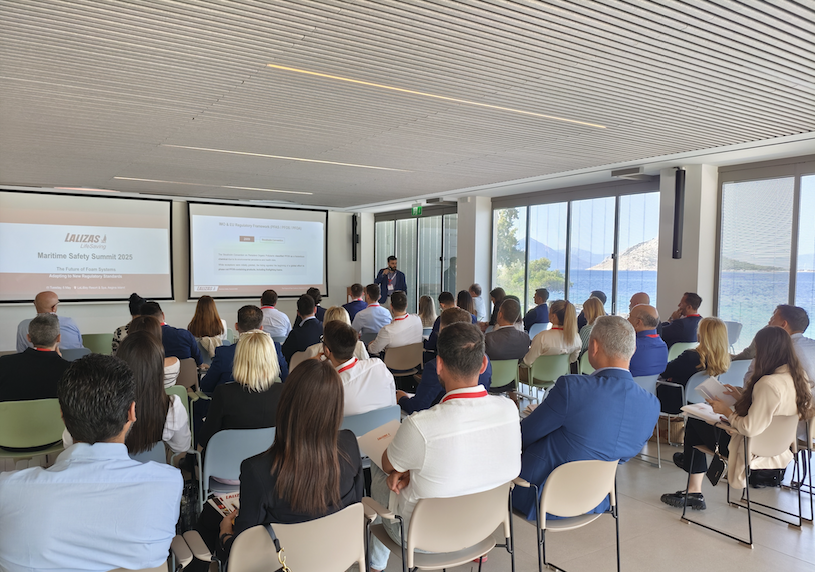
Within this evolving environment, the role of manufacturers extends far beyond supplying certified equipment. At LALIZAS, particular emphasis is placed on supporting operators and crews throughout the entire lifecycle of lifesaving and fire-fighting systems — from regulatory awareness and product selection to training, documentation and long-term operational support. A recent example of this approach was the Maritime Safety Summit 2025, hosted by LALIZAS on Aegina Island, which brought together shipowners, managers, classification societies and other industry stakeholders to examine upcoming IMO regulatory changes affecting foam fire-fighting systems.
The two-day summit focused on the new IMO resolution MSC 532(107), which introduces the prohibition of PFOS- and PFOA-based materials in fixed and portable firefighting systems, with compliance becoming mandatory from 2026. Through open discussion and technical presentations, participants gained practical insight into the regulatory framework, its implications for vessels in operation and the available pathways to compliance. Such initiatives highlight the industry’s need not only for compliant equipment, but also for clarity, expert guidance and informed decision-making.
Ultimately, effective safety management depends on close collaboration with manufacturers that combine technical expertise, global presence and authorised service networks. Through certified equipment, dedicated training solutions, clear technical guidance and a worldwide network of approved service stations, LALIZAS remains committed to helping operators maintain operational readiness and ensure that crews are properly equipped and prepared. Because at the end of the day, safety is not defined solely by regulations or products, but by how well people understand, maintain and rely on the equipment designed to protect them.
By Iasonas Lalizas, Marketing & Communications Director